 Loading...

Auto Draft
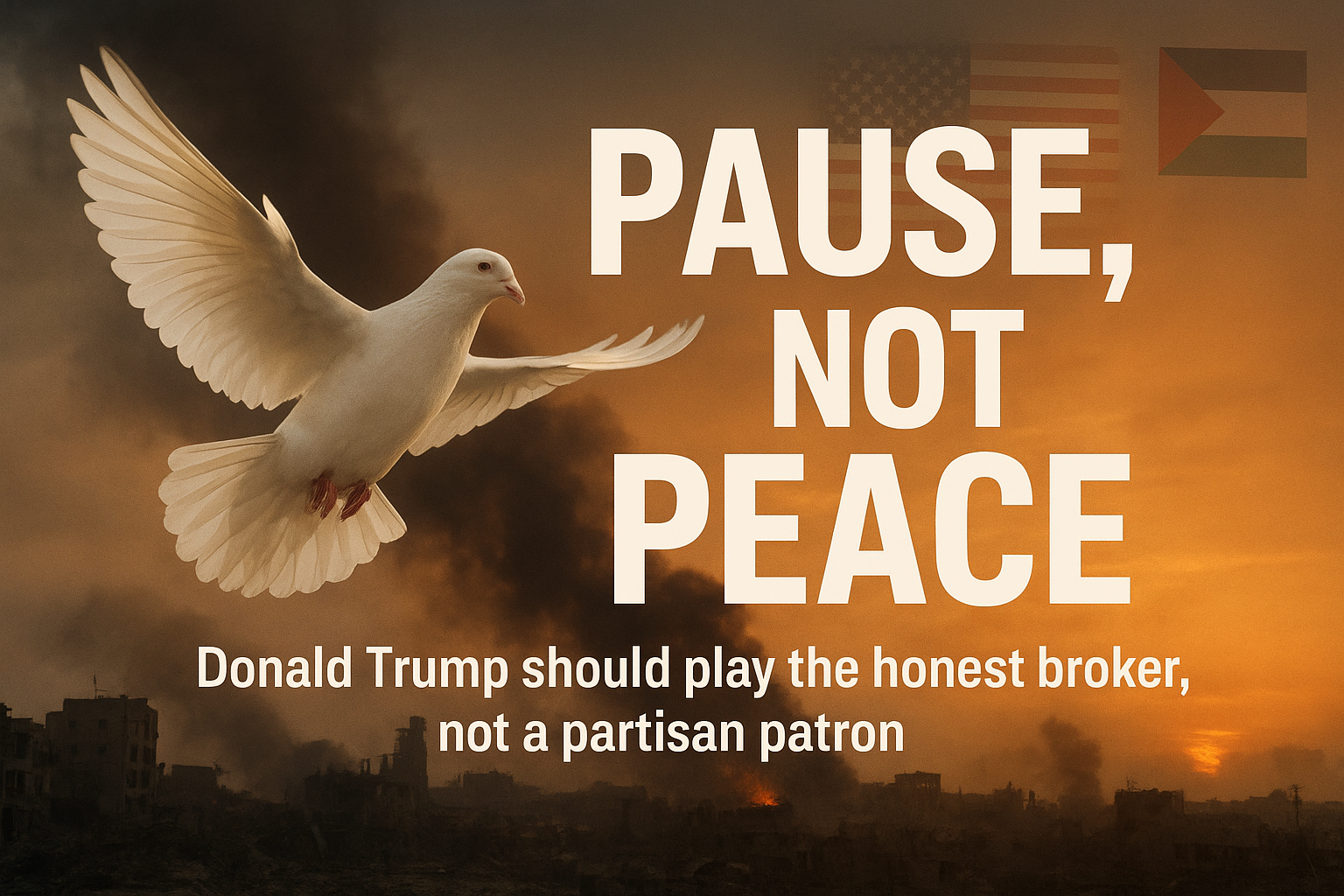
Pause, not peace
Donald Trump should play the honest broker, not a partisan patron
After two years of relentless Israeli bombardment, Palestinians in Gaza are finally getting a reprieve. The ceasefire agreement, signed by Hamas and Israel as part of U.S. President Donald Trump’s 20-point peace plan, brought a pause in Israel’s attacks. Hamas is expected to release all living hostages on Monday and the bodies of the rest on the days after. Israeli troops have already started retreating to the initial withdrawal line, from Rafah in the south to Gaza City in the north along the border, and some 2,000 Palestinian prisoners will be released. Mr. Trump deserves credit for the cease- fire. Until recently, Israeli Prime Minister Benjamin Netanyahu, who always vowed to fight until “total victory”, resisted all calls for a ceasefire. When Israel started the Gaza war, after Hamas’s October 7, 2023 attack, it pledged to “dismantle” the Islamist militant outfit. In two years, Israel has turned Gaza into rubble and displaced most of its 2.3 million people. Its brutal genocidal assault and starvation of Palestinians led to its international isolation. Yet, Hamas remained an unresolved problem. Mr. Netanyahu wanted to continue to fight irrespective of international public opinion. But the U.S., which continues to back Israel militarily and diplomatically, fInally strong-armed Mr. Netanyahu into accepting the ceasefire in return for the release of hostages.
While the ceasefire is a major reprieve for the Palestinians, the hostages and their families, it may not necessarily lead to lasting peace in Gaza. The ceasefire is only the initial phase of the Trump plan, which also calls for demilitarizing Hamas, placing Gaza under an international governance body, and the deployment of an International Stabilization Force for security. In its response to the Trump plan, Hamas agreed to release the hostages but remained non-committal on other terms. Another contentious issue is the continuing presence of the Israel Defense Forces (IDF) in Gaza – after the initial withdrawal, the IDF will still control some 53% of Gaza. Mr. Trump is expected to travel to Egypt on Monday to attend a summit on Gaza — French President Emmanuel Macron and British Prime Minister Keir Starmer will be present. The renewed international attention on the Palestine question is a positive development. But the question is whether these deliberations can bridge the gaps in the Israeli and Palestinian positions, leading to lasting peace. Hamas is unlikely to accept demands to dismantle itself, certainly not after fighting Israeli forces for two years. But it could be pressured to relinquish power in Gaza for a Palestinian authority, backed by international actors, while Israel should be persuaded to leave. For Mr. Trump’s hopes for lasting peace, he should act as an independent broker, not as a partisan patron of one country, and recognise Israel’s security and the Palestinian quest for self-determination.
Overall Analysis
The editorial examines the newly announced Gaza ceasefire mediated under U.S. President Donald Trump’s 20-point peace plan. It opens with cautious relief — acknowledging that the pause offers a much-needed respite to Palestinians after two years of destruction — but quickly questions whether it will translate into true peace. The language throughout mixes realism with skepticism, suggesting that the ceasefire is more a tactical break than a diplomatic breakthrough.
The first paragraph narrates recent events in a factual yet emotionally charged tone. Phrases like “relentless Israeli bombardment” and “turned Gaza into rubble” convey the brutality of the conflict, while verbs such as “strong-armed” show the U.S.’s assertive role in compelling Israel to agree. The editorial credits Trump for achieving a truce but simultaneously implies that his motive may be political, not humanitarian.
In the second paragraph, the analysis deepens: the writer notes that the ceasefire is only the first step of a larger plan with contentious terms — Hamas’s disarmament and partial Israeli presence in Gaza. The structure mirrors uncertainty: clauses are long, dense, and filled with conditional phrases (“may not necessarily lead to lasting peace”), reflecting the fragility of the situation. The editorial’s diction remains formal yet vivid, emphasizing the geopolitical stakes with words like “demilitarizing,” “international governance,” and “stabilization force.”
The final sentences move from reportage to prescription. The piece argues that genuine peace demands impartial diplomacy — urging Trump to act as an “honest broker” rather than a partisan ally of Israel. By concluding on the principle of balance — security for Israel and self-determination for Palestinians — the editorial situates itself firmly within a moral-realist framework: peace cannot endure if it serves one side alone.
Important Vocabulary (5)
Reprieve – a temporary relief or delay from difficulty or punishment.
Ceasefire – an agreement to stop fighting temporarily.
Demilitarizing – removing military forces or capabilities from an area.
Strong-armed – to pressure or coerce someone into doing something.
Broker – a mediator who helps negotiate between opposing sides.
Conclusion & Tone
The editorial views the ceasefire as a fragile pause rather than genuine peace, emphasizing that sustainable resolution requires impartial mediation, not political patronage. It warns that unless both Israeli security and Palestinian statehood are acknowledged, the cycle of violence will resume.
Tone: Analytical, skeptical, and diplomatically critical — blending cautious hope with realism.
