 Loading...

QUE. In Gujarat, the amount of rainfall decreases from south to north and from east to west. – Explain.
June 26, 2026
In the state of Gujarat, located in the west of India, there are mainly eight types of climatic zones. In addition, the distribution of rainfall is affected by the presence of small and large mountain ranges and forests here.
- Factors responsible for the decrease in rainfall from south to north and from east to west in Gujarat:
- The humid winds from the southwest, after bringing rain from South Gujarat, have become dry by the time they reach the north, and some part of the north is made up of hot deserts. Due to this, the moisture present in the winds cannot settle. Therefore, the rainfall there is less. For example, the semi-arid region of Kutch receives less than 40 cm of rainfall.
- Due to the humid winds of the south-west monsoon, the Gir hills, the Girnar mountain range and to some extent the Mandav hills, the southern part receives relatively more rainfall than the north.
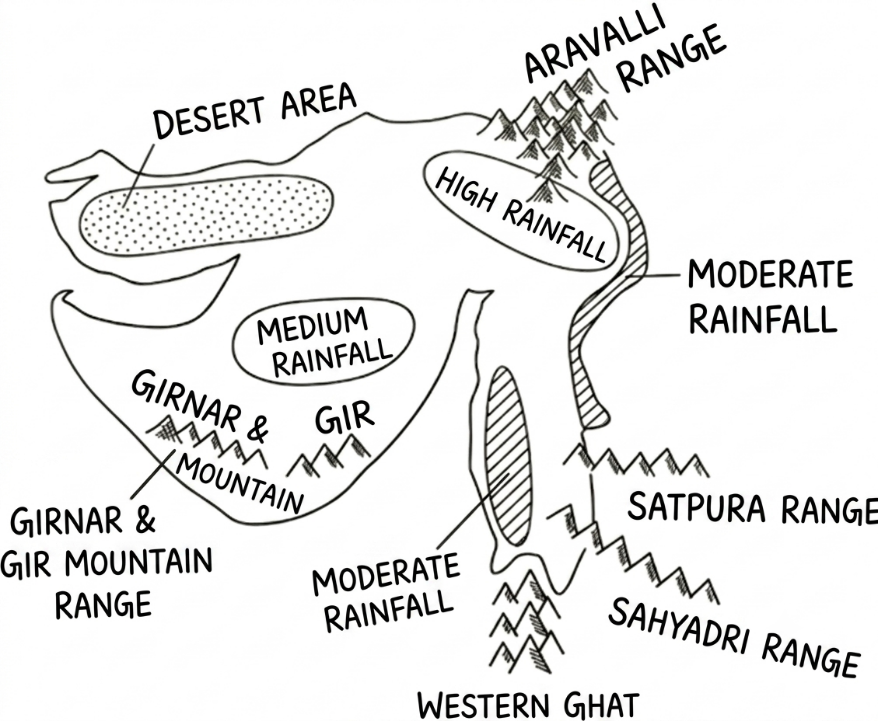
- In South Gujarat, due to the Western Ghats, Sahyadri mountain range, Satpura and Vindhyachal mountain range, it receives more rainfall in the south by blocking the rainy winds and it decreases towards the north.
- The eastern part of Valsad district, located in the southernmost part of Gujarat, receives about 200 cm of rainfall.
- Due to the high proportion of forests in the eastern part of Gujarat, the humidity in the atmosphere is high. Due to this, there is more rainfall there, while towards the western side, the proportion of forests decreases, hence due to the dry climate, there is relatively less rainfall towards the west.
Thus, due to the geographical position of Gujarat, the humid winds of the southwest monsoon and the location of the mountain ranges, the rainfall decreases from south to north and from east to west.
